Free Agent reveals the Ratio 24

6 12 2011

As I’ve said before, Free Agent doesn’t get a lot of hype for its freestyle/trails-oriented 24inchers.

Which is a bit of shame really because for around $400 (US) you get a full cro-mo frame, fork and handlebar along with a pretty respectable parts package on the new Free Agent Ratio 24.

Geometry

In terms of geometry, Free Agent has pretty much stuck with what they used in last year’s Devil 24.

That being:

  • 74 degree head angle
  • 72 degree seat angle
  • 21.5″ top tube
  • 15.2″ chainstay

All in all, not too far out from what you would expect on a bike like this (although they could’ve gone a little shorter on the chainstay).

What they could’ve done better

Given that most companies have adopted the new “standard” of a higher bottom bracket height, it’s a bit surprising that Free Agent stuck with the more race-oriented 12″ bottom bracket height for this year’s model.

Furthermore, the stock handlebar is a sub-6inch offering. While I give them points for spec’ing it in full cro-mo, the trend is decidedly taller these days.

Who might be best suited to this bike

Given the more traditional, race-style geometry (and the full cro-mo construction) this might be a great trails bike for the racer who wants to have a strong bike he can thrash on while keeping his race machine in good shape for the track. The ride should be very similar to a race cruiser so switching back and forth would be a cinch.

Or, if you’re a rider that just prefers more traditional 24″ geometry, this bike is a great option for hitting the trails or skatepark.  A well-spec’ed full cro-mo bike at this price point is hard to beat.


A brake cable for weight weenies

2 11 2011

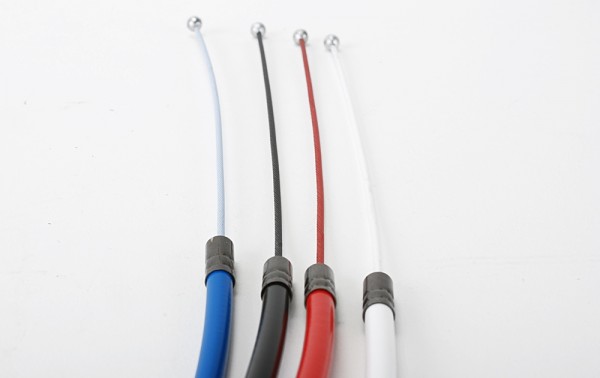
Just when you thought there’s nothing left on your bike that can be made lighter, Odyssey has gone out and developed a lighter brake cable.

That’s right, kids.

Wait.

Kids don’t ride brakes these days.

Anyway, back to what I was saying.

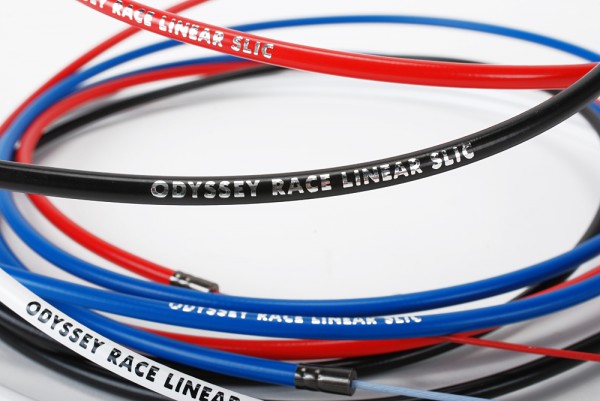
Odyssey has come out with a brake cable, called the Race Linear Slic Kable,  that’s 37% lighter than other brake cables.

How you ask? They’ve taken their popular Linear Slic Kable housing and replaced the steel linear wire with an aluminum one.

I’m extremely curious to see how durable these cables are.

Will they stand up? It’s hard to say right now…they’re still pretty new. But I’m sure we’ll find out soon enough, especially when weight-conscious racers get wind of these.

I do like the added trick factor of the color-coated inner wires and ball ends though (something not available on the regular Linear Kables).

For more on the Race Race Linear Slic Kable, check out the Odyssey Daily Word on it.


Is a two-speed BMX bike just too much?

28 10 2011

Pictures have surfaced recently (on BMXmania and Vintage BMX) of Barry Nobles running a 2-speed at the recent Chula Vista SX race.

Granted, this isn’t the first time 2-speeds have been tried.

Back in the 80s, the Browning 2-speed enjoyed some short-lived popularity but was quickly abandoned due to reliability issues.

I’m not sure how I feel about this development. While it’s cool in a whiz-bang, “maybe it will work this time” kinda of way, it doesn’t feel like BMX to me.

Maybe I’m becoming a curmudgeon in my old age.

But isn’t part of the attraction of this sport the simplicity of the bikes? The race community has already adapted clips, if multi-speed bikes are next, are we just a few years from spandex skinsuits and paved tracks?


Tested: Tall bars on a race cruiser

26 08 2011

A while back the post titled, Traditional cruiser bars: who needs ’em generated a lot of discussion about the trend towards taller bars on 24″ BMX bikes. Part of that discussion also noted how the trend hadn’t really taken hold in the race community.

Racer, BMXActionOnline moderator and today’s guest tester, Matt Shelley thought the idea of taller bars on a race bike was a good one and decided to check it out for himself.

Here’s what he had to say:

The tall bars garnered a lot of interest at the races I attended, and most racers seemed positive toward the idea and feel. The local hot shot, nationally ranked in both 20” and cruiser, balked at the idea, insisting both bikes need to be set up with identical heights and reach. A rider who really liked the feel of my bike replied “all well and good, but if you only ride a cruiser, that rule simply doesn’t apply.”

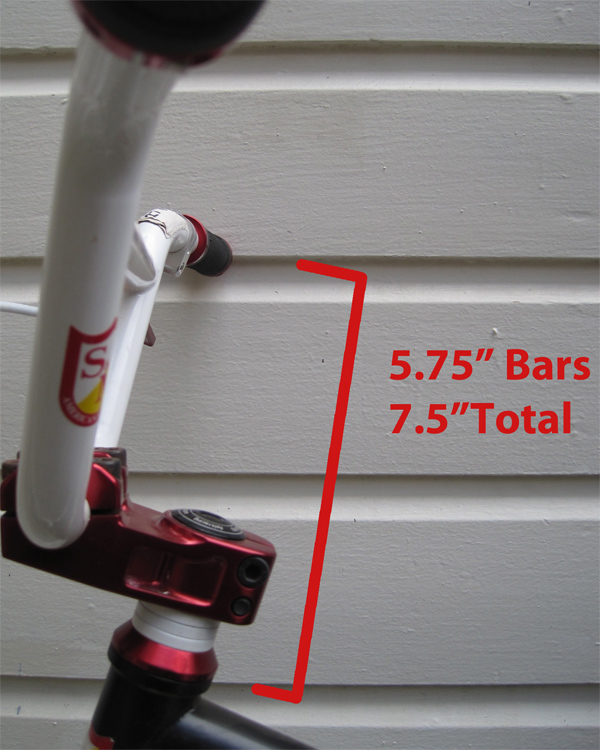
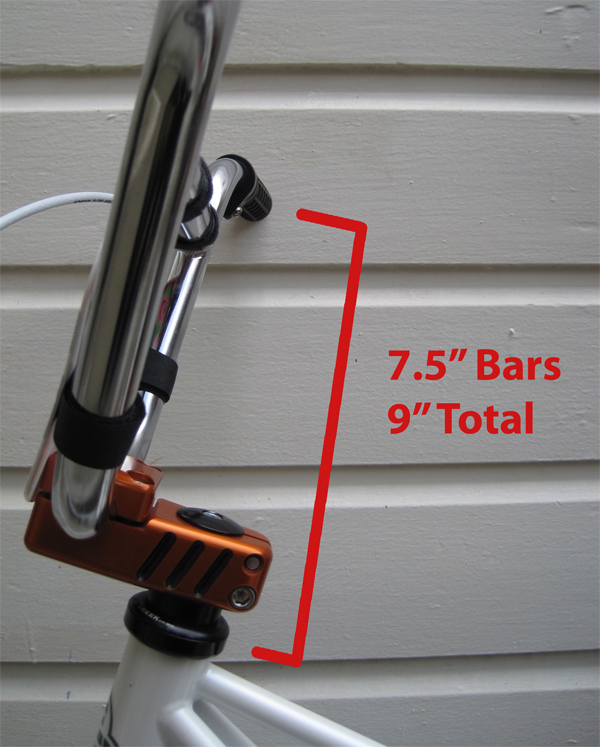
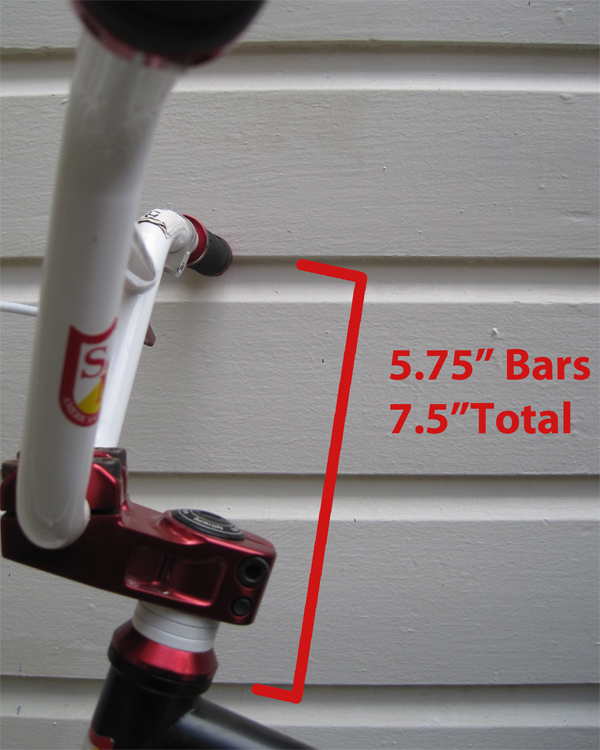
A concern I had with the test was comparing my “apples” to “oranges”. Stack heights and stems vary from bike to bike, so bar height is not the final word in overall height. I decided I would measure from the top of the headset bearing. Whether internal or cup, this seemed like an appropriate starting point, and the middle of the grip area would be the end point.

Below is my main race bike. The bars are 5.75 inches, and the overall height is 7.5 inches.


I’ve been running this setup for close to 2 years now. It seems typical of most race cruisers and feels pretty good to me.

Here is a picture of a Quad that I recently set up. The bars are 7.5 inches with an overall height on 9 inches.

I’ve raced this bike 3 times now, and two 2nds and a 1st have been the result. After the initial half hour of  “this feels different,” I did not notice the bars much after that. I felt that they gave me better pull when manualing and hopping over jumps, and I got the impression I had much better pump with them on backsides.

Another advantage of the taller bars was leg room. I’m 6 feet tall with an inseam of 33 inches. The 6 inch bars I ran on the quad had to be rotated a bit forward, as I felt they were a little too close to my knees. With the 7.5 bars I can now run them in line with the fork.

The only area I felt these  bars to be too tall was out of the gate. I was now standing taller, and thus could not get all of the “give ‘em” out of my hips and into the pedal that I am used too. Aside from those first few pedals, no other detrimental effects on the track were noticed.

I’m now planning to boost the overall height on my main rig to 8 inches. This should give me that better pull and pump I felt, and still allow for a powerful feeling out of the gate.

So taller bars on a race cruiser? Hey, if it feels good… do it!


How to make BMX racing big again

29 07 2011

If you spend any time at all on the BMX racing forums you’ll notice that inevitably, before long,  the subject of “How to grow BMX” will come up.  Another variation of this thread is “Why isn’t racing as popular as it was in the 80s?”

People will argue that you have to one thing or another…from doing presentations at local schools to embracing the whole Supercross track phenomenon.

The trouble is, none of things is doing much to grow the sport.  Yet time after time the same ideas keep getting trotted out.

The solution might be simpler than the collective BMX racing community thinks.

Get a friend hooked on BMX.

Wasn’t it Chris Moeller who said back in the early 90s that the way to make BMX grow was to build up a bike and give it to a friend? (Actually, I’m not 100% sure on this quote but the  research department is out on a patio somewhere right now enjoying a pint so let’s just go with it, ok?)

Matt Shelley got Malcolm hooked on BMX

Matt Shelley, from BMXActionOnline, employs a similar strategy. He chats up folks at the track, all the while with the agenda of getting them out racing.

Check out Matt’s latest success story:

 I met Malcolm at the Fresno Nationals last year. His kid races 13 challenger. We got to talking and he loves bikes, but never considered BMX until he saw us gray beards having so much fun. I dropped some science on him and figured he would do what he will with the advice.

Fast forward to the start of this season… there he is with a craigslist bike, a license, turning hot laps, and getting a ton of encouragement from his son. He admits to having a long way to go (his gates are horrid, natch), but through sheer force of early (and maximum) participation–He is currently leading the state series in 50-54 cruiser!

Nice going Matt (and Malcolm)!

Could it be that easy?

I think so.

I’ve had a few instances myself where friends and friends of friends have approaching me and inquired about getting a bike. Usually it starts with, “I see how much fun you’re having…”

So if you’re concerned about “growing the sport”…talk to your friends about BMX…and build them a bike if you have spare parts lying around.

Spread the word and get your friends out riding. Once you do that, this “growing the sport” business will take care of itself.


BMX racing goes to the dogs

29 04 2011

Aluminum frames, carbon fiber forks, clipless pedals…all have been adopted by the racing community in the quest for victory.

When mere equipment upgrades are not enough, some turn to intense fitness regimes and (gasp!) performance-enhancing drugs.

But it takes more to be a champion.

What it takes is heart….and perhaps four quick moving paws.

Calleigh the BMX dog demonstrates.


Are today’s Pros a bunch of candy-asses?

8 04 2011

Sometimes I wonder how BMX racing lost its mojo.

Don’t get me wrong, I still think BMX racing is cool (I’m a racer myself)…but back in the 80s, it seemed to have that little something extra. Which is a little funny when you think about how tracks, bikes and everything else has improved.

Maybe it’s the style of the racing itself.

Or maybe it’s clipless pedals.

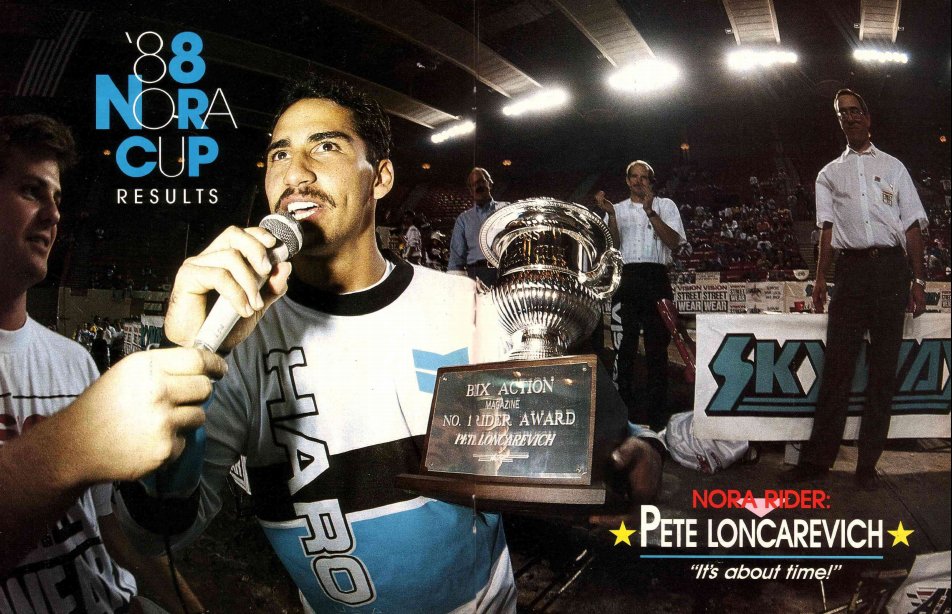
According to 4-time ABA #1 Pro, “Pistol Pete”  Loncarevich, both seem to be culprits.

ESPN caught up with him recently and he was very candid on this thoughts about the current state of affairs in the race scene.

Some interesting quotes:

...less confrontational because of clipless pedals… [racing]seldom gets aggressive

…more candy-ass BMX racing now because no one wants to confront each other on the track

Check it out here (sorry it won’t embed…but it’s definitely worth checking out).

Maybe Pistol Pete is on to something.

Or maybe we just need more WWE-style trash talking between motos.

I envision it going something like this:

Bonus info: It’s Pistol Pete’s birthday today. Respect for the legend.


Renthal reboots the race cruiser bar

16 03 2011

While many in the BMX race world cling for dear life to traditional cruiser bars, it looks like Renthal is ready to mix things up.

A relative newcomer to the BMX race scene, Renthal has long history in motocross.

Red Division, my cruiser blog brother from another (Spanish) mother, is reporting that Keith Wilson from Dialed Bikes is sporting a pair of prototype Renthal bars with a bolt-on crossbar reminiscent of its motorcycle bars. (Keith placed 4th in 45+ cruiser at the 2010 World Cup. )

I have to wonder if there are flex and/or durability issues. It seems to work for them in the motorcycle world so I’m very interested to see how this type of handlebar fares in the bar-banging world of BMX racing.


Traditional cruiser bars: who needs ’em?

1 03 2011

Cruiser handlebars.

Those shorter, stubby versions of traditional BMX handlebars.

They always looked a little off to me.

While 20″ bars got taller, cruiser bars (until recently) stayed  smack dab in the 5-5.5 inch range. Perhaps it was a holdover from the days when people used to switch between their 20 and 24 inch bikes during races (had to keep the handlebar height  the same level for both bikes). Still, it was frustrating that you could not get a taller, cruiser-specific handlebar.

I like big bars, I cannot lie (my apologies to Sir Mix-A-Lot).  Cruiser handlebars under 6″ just don’t cut it. If you’re running bars under 6″, ask yourself:  Are my handlebars big enough?

Thankfully, It seems more and more people are realizing that taller bars are the way to go on 24″ BMX bikes. If you look at some of the more recent bike checks, you’ll see how taller bars are definitely the new trend. Granted, the elevated bottom brackets of current freestyle 24s has had an influence on this…but there’s no denying that a slightly higher handlebar would also help the handling of more race-oriented bikes.

Eva Gabrielle is tired of the bar scene

When I first made the switch to the big & tall 24umph bar from Sunday it made an immediate (positive) impact to my bikes handling. I’ve since run them on both freestyle and race bikes and don’t think I could ever go back to traditional cruiser bars. I’m also pretty intrigued by the new taller 24umph bars they’re testing. Come to think about it, even 8″ bars are not that uncommon on 24″ bikes these days.

Perhaps the only holdout, in this new trend towards taller bars is the race community. Race bikes, by and large, still feature the “regular” 5-5.5″ handlebars. But maybe we’re about to see a change there too…a casual walk through the pits at a BMX race will often show many cruisers rocking spacers and top load stems to give the rider a little extra height. Maybe it’s time for racers to drop the charade and just get  bigger bars.

To me, the days of the traditional cruiser bar are numbered. What do you think?


Talking 24s in Fastlane BMX mag

6 12 2010

I’ve been a fan of Fastlane BMX magazine for a while now.

In an era when racing is all but ignored in the major mags, Fastlane is all about BMX racing.

Sure you can pick up a mag from one of the major U.S. sanctions, look at the token coverage in BMX Plus! or if you can deal with the erratic publishing schedule, find a BMX World (even though it reads like a brochure from the Department of Motor Vehicles).  All in all, not great options.

To me , if you’re into racing (or need to be reminded of how fun racing is) Fastlane is the only mag worth buying. Stories are fun to read, there’s international coverage and great photos. It’s combination that’s tough to beat.

Fastlane doesn’t run hot and cold on 24s either…from cruiser bike checks to regular shots of cruiser riders, Fastlane isn’t afraid to show cruisers some love.

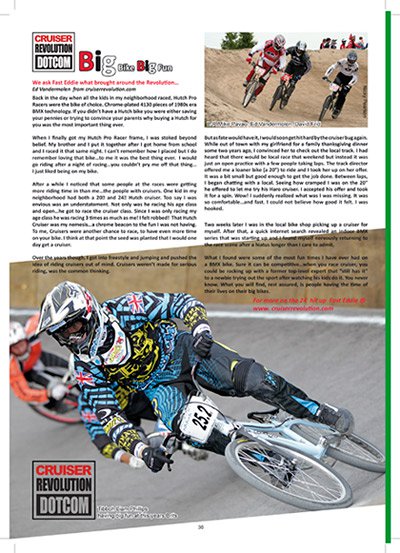
That’s why I was stoked to have the opportunity to write an article about cruisers in Fastlane #8.

(That’s yours truly banging elbows with my friend Carbon in the photo, top right.)

If you’ve ever wondered how I got hooked on the whole cruiser thing, this is something you’ll want to check out.

(Note: Fastlane is UK- based, so visit fastlanebmxmag.com for ordering info.)